The Eras of Women in Australian Disc Sports 50 Years of Flying Disc Sports in Australia · 1976-2026
Through the 1980s and into the early 1990s, Australian disc sport was shaped by a cohort of highly skilled women who rarely confined themselves to a single discipline. Disc golf, freestyle, distance, self caught flight and Ultimate were all part of the same flying disc culture, and women were competing across them all.
One of the most dominant figures of the era was Sandy Castleden (Jarvis). Introduced to disc sports in 1982 by physical education teacher and pioneer Rob Hancock, Sandy quickly established herself as a fierce and versatile competitor. She won her first Australian women’s title in 1983 and went on to secure six Australian Open Championships, with an extraordinary nine national titles between 1982 and 1992. Internationally, Sandy represented Australia at World Championships in Santa Cruz, California in 1985 and 1991, and at the 1991 Canadian Open, where she claimed the women’s title. She also captained the Western Australian state team at a time when Ultimate was contested as a mixed-gender event, reinforcing the collaborative foundations of the sport.
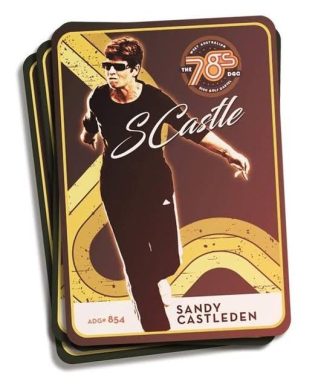
Beyond competition, Sandy was a driving force in the development of disc sport in Western Australia. She held numerous administrative roles including President of the Western Australian Flying Disc Association, working to secure official recognition of Frisbee as a sport with the Western Australian Sports Federation. She was also part of the organising committees for multiple national championships and was nominated for Western Australian Sports Star of the Year. She was recognised with an AFDA Rob Hancock Award in 1994.
This was also the time that a young Sue Conos (now Donnelly) appeared on the scene taking out the freestyle championships in 1981. Sue would later take up Disc golf again and win the women’s masters division in 2024, possibly the longest break between national championships Australian disc sports has seen.
As the sport grew and more men entered competition, increasing specialisation and widening skill gaps began to shift the culture. The early, tightly knit mixed‑gender community that had built the sport together began to fragment. Gail P. Lynch, whose involvement spanned every level of the sport, reflects honestly on this transition.
“Breaking down the barriers to enable improved access and equal opportunities is not easy,” Gail says, “but it can, does and will happen. The recognition of our important role and the ‘difference’ we bring to the sport is changing, and so it should.”
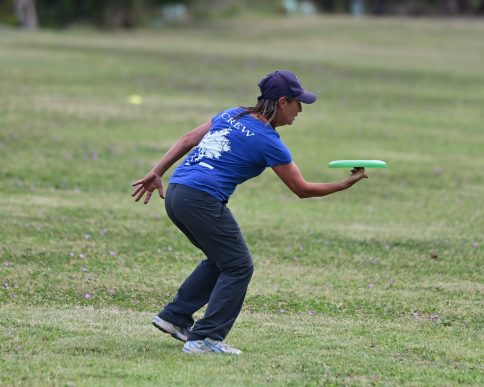
This year marks fifty years since a group of curious players gathered in a South Melbourne park and threw their first Frisbees. In the five decades since, women have been at the heart of Australian disc sports as players, organisers, mentors, and pioneers.
To celebrate this milestone and the 2026 PDGA Women’s Global Event, we’re telling that story in a four-part series. Each week, we’ll share a new era – from the very first throws in 1976 to the thriving community we have today. Along the way, you’ll meet the women who built this sport, often as the only woman on the card, and the new generation who are making sure that’s no longer the case.
Be sure to follow the 50 Years of Flight campaign on Facebook for even more stories, photos, and celebrations as we honour half a century of disc sports in Australia.
Whether you’ve been playing for decades or you’ve never picked up a disc, this story is yours too. The 2026 WGE runs May 15–25, and every woman who shows up is writing the next chapter. Find your nearest WGE event on our website.
We want to take a moment to thank everyone who has helped put this together. A project like this doesn’t happen without the people who capture and embody the spirit of our sport. A special thank you to Emilie Cameron, Cassie Sweetten, Gail P. Lynch, Tenyse Dark, Kingsley Flett (for his photography), and the many other photographers and historians, both known and unknown, whose images and stories help tell the story of Australian Disc Golf. Your contributions are what make something like this possible.
If you would like to help grow the game for women and girls, consider making a donation through the Australian Sports Foundation. This fundraiser is dedicated to supporting the 2026 Women’s Global Event, helping to lower barriers to entry, get more women and girls on the course, and build a future where no one has to be the only woman on the card. Every donation is tax-deductible, and every dollar goes directly toward making disc golf more welcoming and accessible for women at every level. Donate at asf.org.au/preview/back-women-s-disc-golf–wge-2026