For councils and land managers
Costs, land and running a course
What a course costs, how much land it needs, who looks after it, and how to show it is being used.
What a course costs
Real Australian budgets from 2024 to 2026. The biggest swing factors are concrete tee pads, who does the installation, and site works such as tree clearing.
Reported budgets, smallest to largest
Sources: Shire of Shark Bay pilot proposal (Denham, WA); Wagga Disc Golf; ADG NSW state representative; Hobart Disc Golf. All figures AUD and approximate.
| Item (9 baskets, 18 tees) | Estimate |
|---|---|
| 9 heavy-duty baskets with in-ground sleeves, incl. GST and freight | $8,000 |
| 18 concrete tee pads (≈1.5 × 3.5 m) | $9,000 |
| 18 tee signs with timber posts | $2,000 |
| Course map and rules sign | $1,000 |
| 9 “next tee” signs | $500 |
| Installation labour and materials | $2,000 |
| Professional course design (optional) | $3,000 |
| Total | $25,500 |
Build it in stages
Concrete pads are the biggest single line, and they can wait. In Salisbury and Playford, SA, council funding covers all 18 baskets of a new course but may not stretch to every tee pad yet. Clarence opened 9 holes with plans to extend to 18 as grant rounds allow. A short pilot, like the 3-hole Denham proposal at about $5,000, lets a council test demand first.
SourceItemised estimate prepared for Wagga Wagga City Council, July 2024, based on recent NSW projects.
Indicative range
9 baskets, 18 tees · midpoint $22,465
Unit costs come from the Wagga and Denham budgets above and assume volunteer installation. Range is ±20%. Excludes tree work, earthworks, paths, toilets and parking. Get quotes before you submit a budget.
What land it needs
Disc golf works best on land with a mix of mature trees, open lanes and low undergrowth, close to where people live. It does not need exclusive use of a park.
How much space
Canberra’s John Knight Memorial Park course fits 9 baskets and 18 concrete tees into about 3 ha, shared with walkers, cyclists and a playground. Two tees per basket gives two different courses for one set of baskets.
A good site has
- Parking and toilets nearby, with the first tee and last basket close to the car park
- Mature trees with open lanes between them, and low undergrowth
- Clear sightlines to paths, so players can see anyone entering a fairway
- Land that is already mown or slashed, and underused
- Room to grow, or to host an event later
- A population base within about 15 km: most regular players live that close to their home course
Avoid or design around
- Throwing lines toward roads, car parks, playgrounds, picnic areas or private fences
- Young trees that will be damaged by repeated disc strikes
- Thick undergrowth and watercourses that would need clearing
- Land under a management plan that doesn’t allow new recreation uses (common in national parks)
- Areas booked for organised sport, such as AFL, cricket and soccer fields
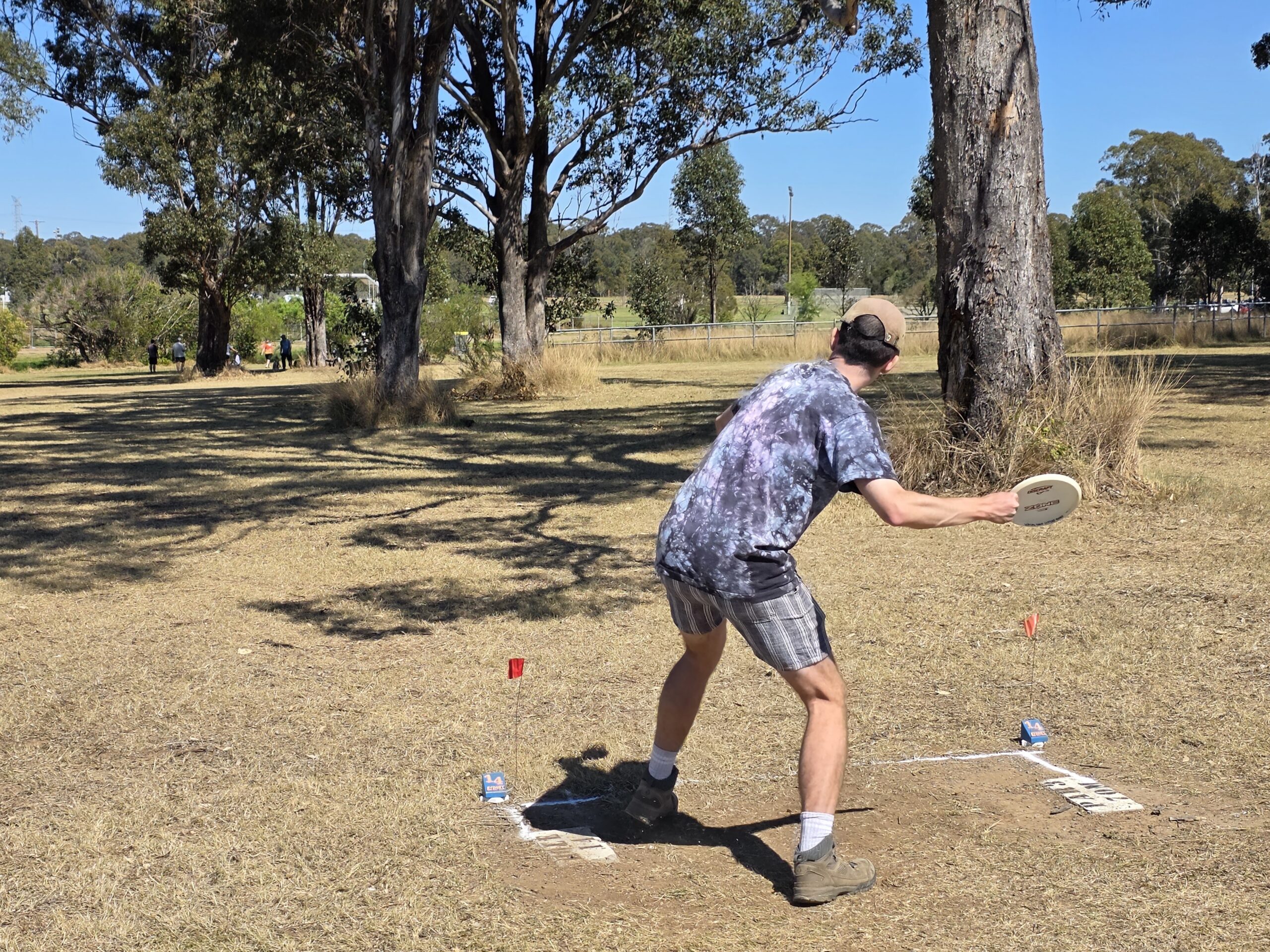
A standard concrete tee pad
Laid flush so mowers pass over. Spray about 50 cm around each basket pole and tee sign to save trimming.
Land types that have worked
Former tip and landfill sites (Kingston, Vic). An old pine plantation once earmarked for soccer (Clarence, Tas). A disused golf course (Belair National Park, SA). A pony club paddock shared with riders (Vic). A bushland reserve with cricket nets (Wagga, NSW).
Not just councils
State forestry, water and parks agencies hold large areas of land and have their own recreation goals. Country golf clubs that have cut back from 18 to 9 holes may welcome a use for the spare land. Schools, universities, camps and caravan parks are also worth asking.
Ball-golf courses: check the fit
Disc golf on golf courses works when it is cheap to play and the course is quiet, as at Sefton, Inverleigh, Mount Xavier and Mundaring. It struggles on busy, pay-to-play courses where tee times are hard to get and green fees are high.
Match the course to its purpose
The regions where disc golf has grown fastest built in this order: a beginner course close to where people live, then a harder course for players as they improve, then a flagship event. Canberra, Newcastle and Perth all followed this pattern.
| Type | Who it suits | Typical layout and land | Australian examples |
|---|---|---|---|
| Pilot or intro | Testing demand, small towns, schools | 3 to 6 baskets, short holes, a town oval or small park | Denham town oval pilot (proposed, WA); small-park courses in Onkaparinga (SA) |
| Community | Families, beginners, casual players | 9 baskets, often with 2 tees each. Holes of 50 to 70 m, 2 to 5 ha, close to housing | John Knight Memorial Park (ACT), Chichester Park (Perth), Seven Mile Beach (Clarence, Tas), King Rodney Park in the Adelaide Park Lands (SA) |
| Intermediate | Regular players, club leagues | 18 holes with longer and more technical holes, around 5 to 10 ha | Eddison Park and Athllon Park (ACT) |
| Championship or destination | Competitive and travelling players, national events | 18 or more long holes with elevation and varied terrain, 12 to 16 ha | Weston Park (ACT, built for the 2018 Australian Championships), Crater Lake (Mount Gambier, SA), Mundaring (WA), Molong (NSW), Poimena Reserve (Hobart, Tas) |

Who owns and looks after it
Councils have used several arrangements. Agree on one early, because maintenance is usually the first thing parks staff ask about.
| Model | How it works | Example |
|---|---|---|
| Maintenance agreement | Council owns the land and course. The club manages the course and takes on agreed mowing and upkeep. | Wagga Wagga, NSW |
| Licence agreement | Council licenses the course area to an incorporated association, in line with the community land management plan. Mount Gambier also discounted the licence fee. | Mount Gambier, SA |
| Council-maintained | Council builds and maintains the course through its open space team. Clubs and schools use it. | Kingston, Vic |
| Community committee | An external park committee maintains the reserve, with council support. | Mathison Park, Latrobe, Vic |
How to measure use
Courses have no gate, so councils rely on a few sources. UDisc, the most-used scoring app, shares free course reports with councils and clubs. App data is a floor rather than a total: experienced players estimate only 20 to 25% of rounds are recorded.
Canberra: unique players per year, four public courses
Rounds grew from 2,961 in 2020 to 11,333 in 2025. Source: UDisc report prepared for Australian Disc Golf, Sept 2026.
Canberra: recorded rounds per course, last 12 months
Athllon Park, the newest, went from 397 rounds in 2023 to 2,009 in 2025. Source: UDisc, 28 Sep 2025 – 27 Sep 2026.
App data
UDisc and Disc Golf Metrix show rounds, unique players, first-time players and how far visitors travelled. Ask the club’s UDisc Course Ambassador, or contact UDisc directly.
On-site counts
A QR code on the main sign linking to a short form (group size, postcode, comments). Disc hire and library loans are a strong signal too: Latrobe counted more than 700 hires in nine months.
Council’s own data
Some councils already count park visits through de-identified mobile location data. Clarence uses it to back up course usage figures.
When the app numbers look thin
A Sydney course ambassador has seen fewer players logging rounds in UDisc over the past few years, so app counts can understate use. Treat app data as a minimum and back it up with at least one count of your own.
- Do a head count. Volunteers tally players at the first tee over two weekends and two weekday afternoons. Repeat each season.
- Ask council for a counter. A trail counter on the path to the first tee, or the council’s mobile location data, gives an independent figure.
- Count what you lend. Disc hire, library loans and school kit bookings all show use by people who never open an app.
- Log groups and events. Record school classes, NDIS and community groups, come-and-try days, leagues and tournaments.
- Present it honestly. Show app data as the floor and your counts as the best estimate. Experienced players estimate apps capture only 20 to 25% of rounds.